Global cybersecurity market size and share report 2026

In an era where cyber threats evolve faster than ever, costing the global economy hundreds of billions annually, cybersecurity has become a cornerstone of digital defense. As a result, cybersecurity has grown into a massive industry. The global cybersecurity market reached $248.28 billion in 2026, up from $218.98 billion in 2025, with projections approaching $700 billion by 2034.
Tools like VPNs and antivirus software sit at the heart of this growth, protecting remote work, online payments, and personal data as AI‑driven threats become more common. This report unpacks the latest size, share, trends, and forecasts of the global cybersecurity market with hard data for informed decisions.
🏷️ LIMITED OFFER: NordVPN deal! Get 76% OFF NordVPN + 3 months FREE 🏷️
Market overview
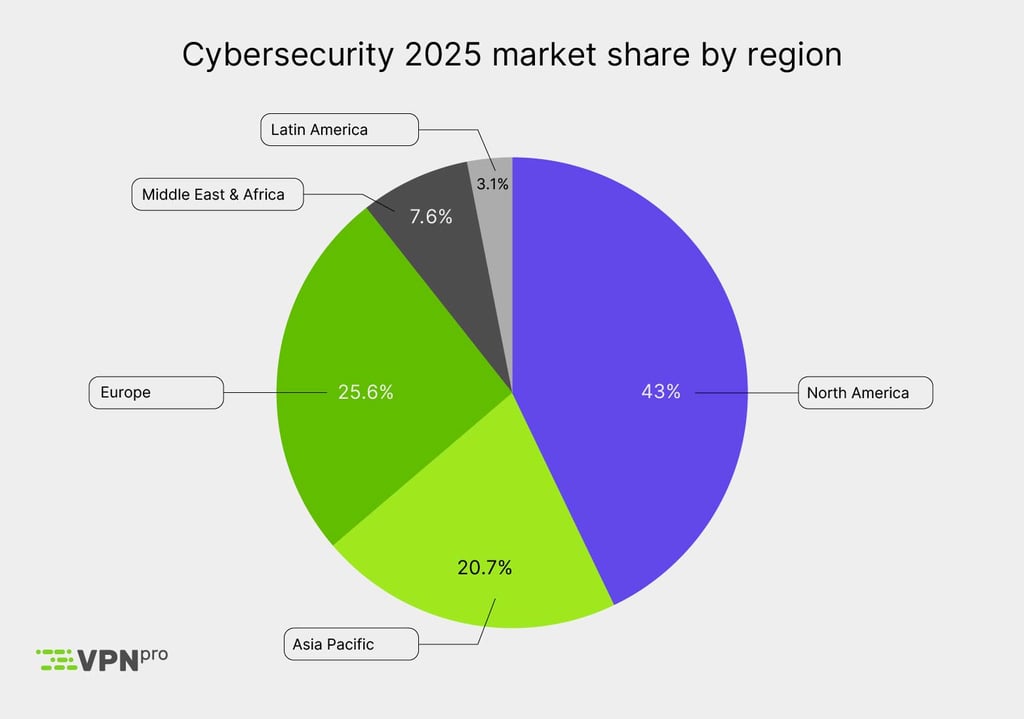
When it comes to the global cybersecurity picture, North America leads with an overwhelming 43% market share, valued at $105.81 billion in 2026, fueled by US investments reaching $81.61 billion. Asia Pacific follows at 20.7% or $52.04 billion, growing fastest due to digital shifts in banking and healthcare. Europe contributes 25.6% via nations like Germany ($11.36 billion) and France ($7.97 billion), while the Middle East & Africa’s 7.6% hits $19.39 billion and Latin America’s 3.1% $7.93 billion, according to a Fortune Business Insights report.
Market growth drivers
Escalating cyber threats like advanced malware, ransomware, and phishing propel demand, fuelling over 14% of annual growth, with North America's breaches boosting cloud security needs. AI integration creates a $2 trillion addressable market, per recent studies.
Rapid cloud adoption and remote work accelerate solutions, including VPNs for secure access and antivirus software for endpoint protection. Governments and firms invest heavily, with US e-commerce growth and Europe's IT projects exemplifying this clearly.
Quick facts from World Economic Forum:
- AI threats doubled attacks in 2025, per reports.
- Remote work boosted antivirus deployments by 35%.
- Regulatory fines hit $4.45 billion globally last year.
All these forces collectively drive the cybersecurity market's explosive trajectory, setting the stage for specialized solutions and services, and how they’re deployed to address specific vulnerabilities in today's online threat landscape.
Get real-time protection with TotalAV
Key segments
Spending tops $520 billion annually by 2026, doubling from $260 billion in 2021, as AI expands the market, according to Cybercrime Magazine. Hardware holds 54.2% revenue share, powering real-time threat monitoring across networks and devices. Cloud security emerges as the fastest-growing segment, demonstrating a 15.9% CAGR (compound annual growth rate) through 2033 and proving vital for securing hybrid work environments.
Meanwhile, VPNs and antivirus solutions remain essential for everyday privacy protection. VPNs shield sensitive data flows during transmission, while antivirus software combats malware responsible for roughly 90% of breaches, according to key industry trends.
| Segment | 2025 trend | Growth insight |
| Hardware | Dominating revenue share | Prevents system entry |
| Cloud | Fastest growing rate | Remote workforce driver |
| Network | High US demand | Enterprise focus |
Regional breakdown
Asia Pacific's digital boom, particularly in China and India, promises large growth as rapid tech adoption fuels cybersecurity demand. Europe's regulatory push, exemplified by strict GDPR enforcement, sustains steady momentum across the continent. Meanwhile, emerging markets in the GCC (Gulf Cooperation Council) region, with a projected $6.92 billion valuation, use strategic partnerships to accelerate growth.
| Region/key market | Market value/detail | Key driver |
| North America (US) | $81.61 billion | 60% cloud adoption |
| Asia Pacific (India) | 18% CAGR | 1.5 billion internet users |
| Asia Pacific (China) | $25 billion investments | Digital expansion |
| GCC | $6.92 billion projected | Strategic partnerships |
Top players analysis
Leading companies like Palo Alto Networks, holding an estimated 15% market share, alongside CrowdStrike and Cisco, are spearheading growth through cutting-edge AI innovations that enhance threat detection and response times. Microsoft dominates in cloud security, powering scalable solutions for enterprises shifting to hybrid environments, while Fortinet maintains a sharp edge in hardware, bolstering firewalls and endpoints critical for real-time protection.
According to Data Bridge market research, here are the key contributors from top players:
- Palo Alto Networks: 15% share via AI-driven platforms.
- CrowdStrike: Falcon platform leads endpoint detection.
- Cisco: Network security integrations fuel enterprise adoption.
- Microsoft: Cloud dominance with Azure Sentinel expansions.
- Fortinet: Hardware firewalls capture 20%+ segment growth.
Cybersecurity trends
In 2026, cybersecurity trends show a dynamic shift toward proactive defenses, with zero-trust models surging 25% in adoption as they integrate VPNs for continuous verification across networks and users. Complementing this momentum, AI-powered defenses now counter over 90% of automated attacks, delivering real-time shielding against rapidly evolving threats.
VPN and antivirus role
VPNs play a pivotal role in securing 40% of remote work sessions, with their market subset valued at $50 billion as businesses prioritize encrypted connections. Antivirus solutions complement this by blocking 95% of malware threats, proving essential in addressing 70% of all breaches where malicious software strikes first.
The VPN segment continues its 17% CAGR course, driven by growing privacy demands in an age of data surveillance and geo-restrictions. Meanwhile, antivirus tools are evolving through AI integrations that boost detection rates by 30%, offering smarter, real-time protection against sophisticated attacks.
Future projections
These advancements push the overall market toward $663.24 billion by 2033 and almost $700 billion by 2034, while AI innovations unlock a staggering $2 trillion opportunity in the sector.
| Year | Size (USD billion) | Key driver |
| 2026 | 248.28 | AI threats |
| 2033 | 663.24 | Cloud shift |
| 2034 | 699.39 | Regulations |
Cybersecurity market challenges 2026
Rising cyber threats continue to outrun organizational defenses in 2026, with 85% of firms struggling with critical skill gaps that hinder effective implementation. Even as the global market size reaches $248 billion, persistent budget constraints throttle widespread adoption of advanced tools, leaving many vulnerable to escalating attacks.
Core challenges, based on Grand View Research and supporting sources:
- Talent shortage: 4 million cybersecurity jobs remain unfilled worldwide.
- AI exploits: 60% of breaches now leverage machine learning-based hacks.
- Supply chain risks: 40% of attacks originate from third-party vendors.
Mitigation Strategies
Organizations can counter these hurdles by layering VPNs with antivirus solutions, achieving up to a 50% reduction in overall risk exposure, while zero-trust architectures slash insider threats by 70%.
| Challenge | Impact (%) | Solution |
| Skills gap | 85 | Training investments |
| AI threats | 60 | Adaptive tools |
| Regulations | 30 | Compliance audits |
Emerging technologies impact
Amid these pressing challenges, emerging technologies offer both new risks and powerful opportunities to bolster cybersecurity resilience:
- Quantum computing looms as a major disruptor, poised to crack traditional encryption by 2030 and ignite a $10 billion post-quantum cryptography market.
- Blockchain technology fortifies IoT ecosystems with 25% yearly growth, enhancing tamper-proof data flows.
- 5G vulnerabilities expand the attack surface by 300% with denser connectivity.
- Edge computing heightens the need for real-time VPNs to secure distributed data processing.


Since 2018, VPNpro has delivered unbiased, expert-backed insights through in-house research and thorough VPN testing. Our team ensures every review is fact-checked and reliable. Learn how we maintain these high standards in our testing methods.
Conclusion
As cyber threats intensify across AI, ransomware, and IoT vulnerabilities, the quarter-billion-dollar cybersecurity market in 2026 stands as a digital frontline defense, led by North America's dominance, Europe’s regulation, and Asia Pacific's rapid rise.
Embracing layered solutions like VPNs and antivirus software, alongside zero-trust and cloud innovations, equips organizations to slash risks and thrive amid hundreds of billions in cybercrime costs. In 2026 and beyond, being informed and making proactive cybersecurity investments is non-negotiable for digital survival for both individuals and companies globally.

![Surfshark weekly deals logo [IN USE]](https://media.vpnpro.com/surfshark-weekly-deals.svg)
![Proton VPN winner logo [IN USE]](https://media.vpnpro.com/2025/05/protonvpn-winner.png)
Sources and methodology
This report draws from authoritative industry analyses, including comprehensive cybersecurity market projections from Fortune Business Insights, segment breakdowns from Grand View Research, Cybersecurity Ventures' 2026 forecasts, the World Economic Forum's Global Cybersecurity Outlook 2026, and other sources. All statistics presented reflect the original data from these trusted publications without modification, ensuring readers receive accurate, unaltered insights into market size, growth trends, and regional dynamics.
FAQ
What is the size of the global cybersecurity market in 2026?
The global cybersecurity market reached $248.28 billion in 2026, up from $218.98 billion in 2025. The growth is mainly driven by surging demand for defenses against AI-powered threats and ransomware.
Which region leads the cybersecurity market share?
North America holds the largest share at 43% ($105.81 billion in 2026), fueled by heavy US investments. On the other hand, the Asia Pacific region grows fastest with a 20.7% share amid digital booms in China and India.
What are the fastest-growing cybersecurity segments in 2026?
Cloud security is estimated to lead at over 15.9% CAGR through 2033, vital for hybrid work. Hardware dominates with 54.2% share, while VPNs and antivirus software still remain crucial, securing remote sessions and blocking 95% of malware.
What does the cybersecurity market look like in the near future?
Projections show the market hitting $663.24 billion by 2033 and $699.39 billion by 2034 at a 13.8% CAGR. Meanwhile, trends like zero-trust (up 25%) and post-quantum tech are to address rising ransomware and IoT risks.


