VPN usage statistics by country 2026


VPN usage is increasing across the world for different reasons. In some countries, users are seeking to bypass increasing government censorship around topics such as access to adult content and access to unbiased news. In other countries, government censorship has made it essential to keep your browsing private and avoid persecution.
Working with VPNpro's research team, I've analyzed download and usage data for the most popular VPN providers to find out how VPN usage has increased over the past five years.
![NordVPN responsive banner logo [IN USE]](https://media.vpnpro.com/images/160x40/2025/08/nord-responsive.png)
🏷️ LIMITED OFFER: NordVPN deal! Get 76% OFF NordVPN + 3 months FREE 🏷️
Top 10 countries with the highest VPN usage rates
Summary: Gulf countries like the UAE and Qatar lead with the highest VPN usage as a percentage of the population, due to strict internet restrictions imposed by the government. Other countries like the UK feature high in VPN usage statistics, likely in part due to recent changes in the law that have tightened internet access around adult content.
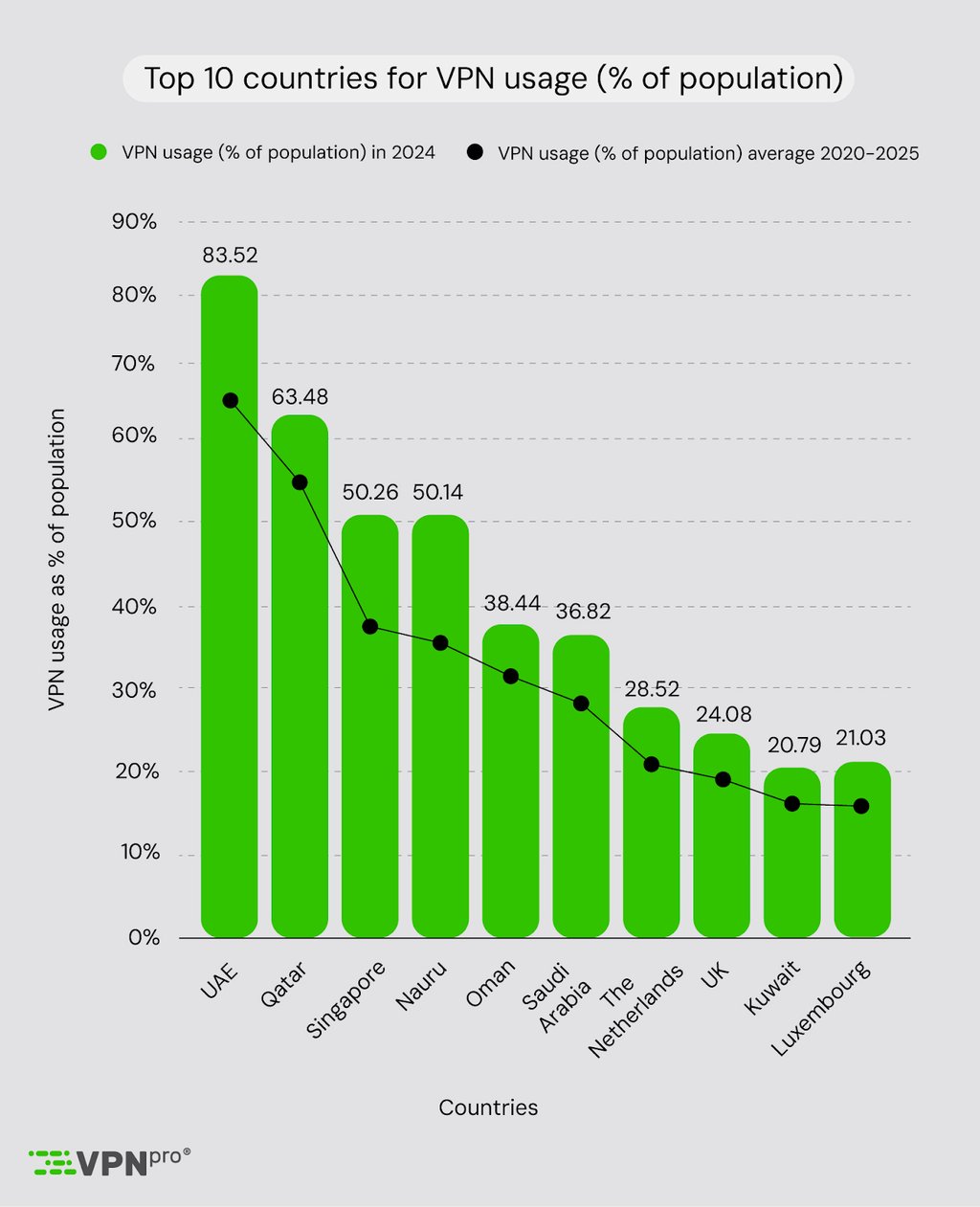
Countries with the highest VPN usage rates tend to fall into two categories
- Regions with strict internet controls: These are countries where the government imposes strict internet filters to limit and control access to information, such as Russia, Iran, and China.
- Digitally advanced countries with high privacy needs: These are countries like the United Kingdom, where the internet is still largely free, but users want to bypass adult content filtering or prevent their ISP from tracking their activity.
Based on multi-year VPN usage data, the following countries consistently rank highest:
| Country | VPN usage (% of population) |
| 1. UAE | 65.78% |
| 2. Qatar | 55.43% |
| 3. Singapore | 38.23% |
| 4. Nauru | 35.49% |
| 5. Oman | 31.04% |
| 6. Saudi Arabia | 28.93% |
| 7. Netherlands | 21.77% |
| 8. United Kingdom | 19.63% |
| 9. Kuwait | 17.88% |
| 10. Luxembourg | 17.30% |
Based on this research, Gulf countries tend to dominate the top positions, including the UAE and Qatar. In these regions, VoIP services like WhatsApp and Microsoft Teams are often blocked. Many other websites, including gambling and adult content are also restricted. Users can only access such content, including critical business tools for communication, by using tools like a VPN.
VPN usage by region (global breakdown)
Regional trends help to give us a clearer picture of how VPN usage differs across the world. For example, while around 65% of the population of the UAE uses a VPN, the Middle East represents the smallest actual worldwide market share when it comes to VPN users:
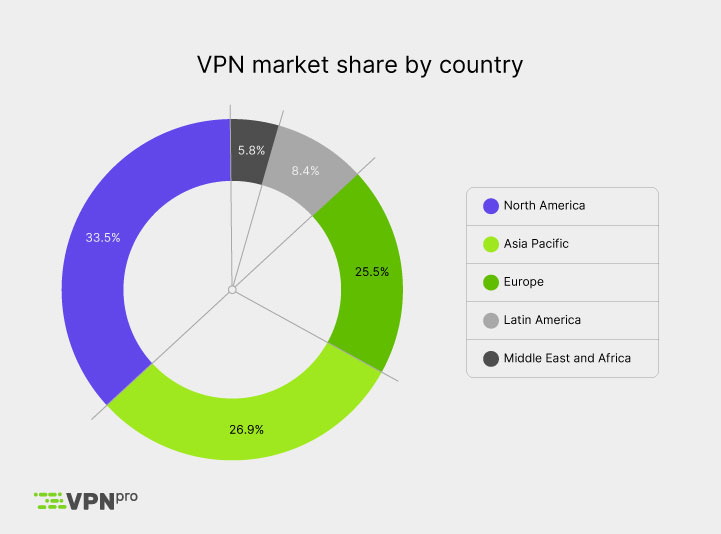
Below, I’ve included key insights into different regions based on our research into VPN usage, highlighting how the situation varies across the world.
Asia-Pacific
Asia-Pacific has one of the largest VPN markets globally, both in terms of total users and overall adoption rates. According to Statista, the region accounts for over half of the world’s internet users, with countries like India alone contributing more than 750 million users, and Southeast Asia continuing to see double-digit growth in connectivity.
This scale directly translates into high VPN usage. For example, Indonesia has one of the highest VPN adoption rates globally at around 55% of internet users, while India follows at roughly 43%. These figures place parts of Asia-Pacific well above the global average, where roughly 23% of internet users use a VPN.
- VPN usage is driven by both entertainment and access, with streaming and gaming among the most common use cases.
- Large population regions like India and Indonesia contribute hundreds of millions of users in real terms.
- Mobile-first internet usage dominates, with over 90% of users in some Southeast Asian markets accessing the net via smartphones, making VPN apps accessible.
Overall, Asia-Pacific’s combination of massive user bases, high degree of mobile internet access, and above-average VPN usage rates makes it the single biggest contributor to global VPN demand in 2026.
🔗Learn more about the best VPNs for India & Indonesia
Europe
Europe shows lower but consistent VPN usage compared to Asia-Pacific, which is largely due to strong privacy needs combined with high internet usage.
According to DataReportal’s Digital 2025 Global Overview Report, Europe has some of the highest internet penetration rates globally, often exceeding 90% in countries like the UK, Netherlands, and Germany. This creates a large user base where VPN adoption is driven more by user choice than necessity, as internet freedom is much stronger in European regions.
VPN usage across Europe typically ranges between 15–25% of internet users, depending on the country. For example, survey data collated by Statista shows us that around 19% of UK internet users use a VPN.
Unlike regions with heavy censorship, VPN usage in Europe is mostly driven by:
- Privacy concerns: This is particularly true around ISP tracking and data collection by other companies. Users choose a VPN to obscure their internet activity and prevent companies from tracking and collecting their data.
- Streaming and geo-unblocking: Users unblock foreign streaming services to watch sports, access international content libraries, or simply log into their own streaming platforms while abroad.
- Public Wi-Fi security: Public internet networks are notoriously unsafe, so users take advantage of a VPN’s encryption and other security tools to protect their devices while using these networks at home or while traveling.
Overall, Europe represents a mature VPN market, where usage is closely tied to privacy awareness rather than access limitations. However, VPN usage is rising due to recent changes in the law, with countries like the UK, France, and Germany implementing age-verification processes for adult content, for example. In these regions, users use a VPN to unblock content without risking their privacy.
🔗Learn more about the best VPNs for Europe
North America
North America is characterized by high awareness of VPNs but more selective usage trends. According to the Security.org VPN Consumer Report, 46% of US adults have used a VPN at some point. However, regular, sustained usage is lower, suggesting that many users rely on VPNs for specific use cases instead of wanting continuous protection and privacy.
At a more granular level, around 20–25% of internet users in the United States use VPNs regularly, putting the region close to the global average of roughly 22–23% and not within the 10 countries that boast the highest VPN usage by percentage of population.
At the same time, adoption is not universal. The same Security.org report notes that a significant portion of users either don’t fully understand VPNs or don’t feel a need to use them regularly, indicating ongoing growth potential.
The United States tends to share the same use cases as European uses, including streaming, security, and protection against tracking. Unlike regions with stricter internet controls, VPN usage here is rarely driven by censorship.
🔗Learn more about the best VPNs for USA
Middle East & Africa
The Middle East & Africa region consistently records some of the highest VPN usage rates globally due to government restrictions and limited internet freedom. Gulf countries dominate global rankings, with countries like the UAE and Qatar seeing VPN usage exceed 50% of the population.
According to Freedom House’s Freedom on the Net report, many countries in this region have strong restrictions on social media platforms, VoIP services, and independent news outlets. In more restrictive environments like Iran, usage is widespread, with surveys indicating that around 81% of internet users rely on VPNs to bypass censorship.
In Africa, overall VPN usage is currently lower but growing rapidly. According to DataReportal, the region is experiencing some of the fastest internet adoption growth globally, which is expected to drive increased VPN usage over time.
🔗Learn more about the best VPNs for Africa
VPN usage trends over time (2020–2026)
VPN usage has grown significantly over the past five years, but the trend has not been linear. Instead, adoption has followed three distinct phases: a sharp surge during the COVID-19 pandemic, steady global expansion, and more recent stabilisation as VPNs become a mainstream tool.
2020-2021: pandemic-driven surge
The most dramatic increase in VPN usage occurred during the COVID-19 pandemic, when remote work and lockdowns pushed millions of people online.
According to Statista, VPN usage in the United States increased by 124% in March 2020 alone, as businesses rapidly transitioned to remote working and required secure connections.
This period marked a major shift in how VPNs were perceived. Previously seen as tools for businesses or tech-savvy users, VPNs quickly became essential for everyday activities like working from home, accessing company systems, and securing personal connections on unfamiliar networks.
2022-2024: rapid global uptake of VPNs
Following the initial surge, VPN adoption continued to grow as awareness of privacy risks and online restrictions increased. Research covering over 100 countries shows that average VPN adoption rose from 6.95% in 2020 to 10.58% in 2024, reflecting consistent year-on-year growth.
At the same time, the total number of users increased significantly. Estimates suggest that there were over 1.5 billion VPN users globally by 2024, driven by expanding internet access and rising demand for online privacy.
2025-2026: increasing usage due to regional trends
In 2025 through 2026, VPN usage is continuing to increase when compared to the percentage of the population in all of the top 10 countries, as we’ve seen earlier. Average uptake has been higher in 2025 than the average for 2020-2025, and this is likely due to a number of global trends:
- Countries imposing stricter internet controls: Data shows that VPN-related search interest can surge by as much as 3,000% following internet blocks, and countries like France, the US, the UK, and Australia have been tightening restrictions in recent years.
- Age verification processes for adult content: Adults are increasingly turning to VPNs instead of supplying personal identification and risking their privacy.
- Global conflict: In countries such as Russia and in parts of the Middle East, the public faces prosecution for accessing western news sources or sharing information on social media. Users increasingly turning to VPNs likely want to protect themselves.
Try NordVPN risk-free and protect your privacy today
Methodology
To compile this report, the VPNpro research team drew on up-to-date data from trusted sources such as Freedom House, Statista, and DataReportal, before analyzing key trends and statistics to form our opinions. All sources used have been referenced throughout the article.
Conclusion
VPN usage in 2026 shows us a shift toward mainstream adoption. Around 22–23% of global internet users now use a VPN, with much higher rates in regions like the Middle East, where internet restrictions and privacy concerns are high, and usage exceeds 50% in countries such as the UAE and Qatar.
At the same time, other countries continue to see increased VPN usage as a result of increasing access to the internet. In some markets, like the UK, US, Australia, and parts of Europe, uptake is exploding as a result of recent changes in the law around adult content and social media filtering.

![Surfshark weekly deals logo [IN USE]](https://media.vpnpro.com/surfshark-weekly-deals.svg)
![Proton VPN winner logo [IN USE]](https://media.vpnpro.com/2025/05/protonvpn-winner.png)
FAQ
What percentage of people use a VPN globally?
Around 22–23% of global internet users use a VPN, according to recent survey data. This means roughly one in four people uses a VPN to access the internet. Usage rates vary significantly by region though, with much higher usage rates in countries with stricter internet censorship.
Which country uses VPN the most?
The United Arab Emirates (UAE) ranks as the country with the highest VPN usage, with around 65–66% of the population using a VPN. Other countries with similarly high usage include Qatar and Oman. These high levels are mostly due to restrictions on VoIP services, social media, and broader internet regulations.
Which countries have the fastest-growing VPN usage?
VPN usage is growing fastest in countries like India, Brazil, Turkey, and Nigeria. These regions are seeing fast increases in mobile internet access, coupled with rising problems with content restrictions.
Why is VPN usage high in the Middle East?
VPN usage is high in the Middle East as a result of government internet restrictions. Services like WhatsApp calls, some websites, and streaming platforms are either partly restricted or blocked. As a result, users rely on VPNs to access these services.


