HIPAA compliant VPN Services in 2026


The Health Insurance Portability and Accountability Act (HIPAA) sets strict rules on how healthcare providers and related organizations must protect sensitive patient, employee, and client information. With the growing reliance on digital tools and remote work, meeting these standards becomes more and more challenging.
One of the biggest obstacles is keeping data protected when staff use personal devices or connect from outside the office. These remote connections are major targets for cybercriminals, especially when files are shared over unsecured networks like public Wi-Fi. Without strong safeguards, private health data is at risk of exposure and costly compliance breaches.
A HIPAA compliant VPN offers a reliable solution. By encrypting traffic and shielding devices from cyberattacks, it ensures that sensitive records remain safe and inaccessible to unauthorized parties. For healthcare professionals working remotely, VPN protection can make all the difference.
In this article, I’ll explore how HIPAA works, why VPNs play a critical role in compliance, and which services in 2026 deliver the best security for healthcare organizations.
🏷️ LIMITED OFFER: NordVPN deal! Get 76% OFF NordVPN + 3 months FREE 🏷️
Best HIPAA compliant VPN for personal use: shortlist
- NordVPN – the best VPN to ensure HIPAA compliance with top-notch protection features
- Surfshark VPN – excellent HIPAA VPN for multiple devices
- Proton VPN – security-first HIPAA-compliant VPN with a versatile toolkit


Since 2018, VPNpro has delivered unbiased, expert-backed insights through in-house research and thorough VPN testing. Our team ensures every review is fact-checked and reliable. Learn how we maintain these high standards in our testing methods.
What is HIPAA compliance?
To put it plainly, HIPAA is a set of regulatory standards that cover the handling and protection of PHI (Protected Health Information) by healthcare organizations. And this data has to be kept from the wrong hands, as it can be used to identify (and target) patients, workers, and other clients.
HIPAA covers 18 identifiers:
- Name
- Address
- Dates (includes birthdays, admission/discharge dates, and so on)
- Phone number
- Fax number
- Email address
- Social security number
- Medical record number
- Health plan beneficiary number
- Account number
- Certificate/license number
- Information related to owned vehicles (vehicle identifiers, license plate numbers, serial numbers)
- Owned device identification or serial numbers
- Web URLs
- IP address
- Biometric identifiers
- Photos
- Any other unique characteristics
It also encompasses all information transmitted, stored, or accessed electronically, commonly referred to as ePHI these days. To stay compliant, every person handling such data must ensure it remains secure, and the most effective tool for individual use is a reliable VPN. This is especially the case when you’re working remotely or via personal devices.
Failure to ensure that all HIPAA regulations are met can result in dire consequences. Substantial monetary losses are one thing, but a breach of ePHI data will also cost the organization its reputation and patient trust. And you have to prepare for criminal charges and lawsuits as well.
HIPAA violation tiers
A HIPAA violation is the failure to comply with the regulations set by the Health Insurance Portability and Accountability Act. It doesn’t have to necessarily result in a data breach for it to be considered a violation.
Currently, HIPAA violations are categorized into 4 tiers according to severity, the healthcare organization’s culpability, and the effort made by the institution to correct the mistakes once they are identified.
| Penalty category | Level of culpability | Minimum penalty per violation | Maximum penalty per violation | Annual penalty limit |
| Tier 1 | Lack of knowledge | $127 | $31,987 | $31,987 |
| Tier 2 | Reasonable cause | $1,280 | $63,973 | $121,946 |
| Tier 3 | Willful neglect | $12,794 | $63,973 | $304,865 |
| Tier 4 | Willful neglect not corrected within 30 days | $63,973 | $1,919,173 | $1,919,173 |
Here’s a more detailed explanation of the violation tiers:

Understandably, HIPAA violations can occur either intentionally or accidentally, and the tiers take that into account. Some of the most common transgressions are:
- Lack of HIPAA compliance training
- Failure to encrypt data
- Exposing ePHI by sharing it via open networks
- Failure to safeguard devices that contain ePHI, such as computers, phones, tablets, USB devices, etc.
- Disclosing incorrect patient information when transferring records
- Improper disposal of ePHI
- Social sharing
Another crucial aspect worth mentioning is that you can be fined on a personal basis if the investigation finds you responsible for criminal offenses. Thus, you have to take proper action to mitigate the potential infractions on your part, too.
Is VPN HIPAA compliant?
Due to their nature, VPNs are HIPAA compliant as they ensure the user’s privacy and enhance the security of their devices. Still, just because a service claims to be compliant doesn’t necessarily mean it is or is suited for this task in general.
A reliable VPN provider must have a spotless reputation and top-tier security measures to protect both the data and the devices it’s stored and shared on. Furthermore, you should look for privacy-friendly jurisdictions, audited no-logs policies, and secure tunneling protocols.
If you’re a medical practitioner working from home or on the go, I recommend arming yourself with the right HIPAA-compliant VPN service. During my extensive research, I’ve found several providers that meet all requirements to a T.

HIPAA VPNs for personal use
- NordVPN. The best VPN to ensure HIPAA compliance. The service hails from Panama, adheres to a thrice-audited no-logs policy, offers open-source apps, and comes with industry-leading security features. Besides the ultra-robust VPN suite, you can additionally get a password manager, a data breach scanner, and 1 TB of secure cloud storage. Plus, it’s highly affordable and easy to use, so even less tech-savvy individuals have no problem utilizing it.
- Surfshark VPN. An excellent HIPAA-compliant VPN that lets you secure an unlimited number of devices. The service went through a no-logs policy and app security audits and passed them with flying colors. Furthermore, you can purchase the Surfshark One add-on that includes an antivirus, a private search tool, and a data breach scanner.
- Proton VPN. A security-first VPN, more than suitable to meet HIPAA requirements. It’s Swiss-based, open-source, and audited. The company behind it also offers loads of other safety solutions, such as an encrypted email service, a private calendar, and secure cloud storage.
Use NordVPN to ensure HIPAA compliance
How do VPNs ensure HIPAA compliance?
If you’re working remotely or using a personal computer or phone for medical work, there are specific HIPAA privacy and security issues that need to be mitigated. Fortunately, a HIPAA-compliant VPN solves them.
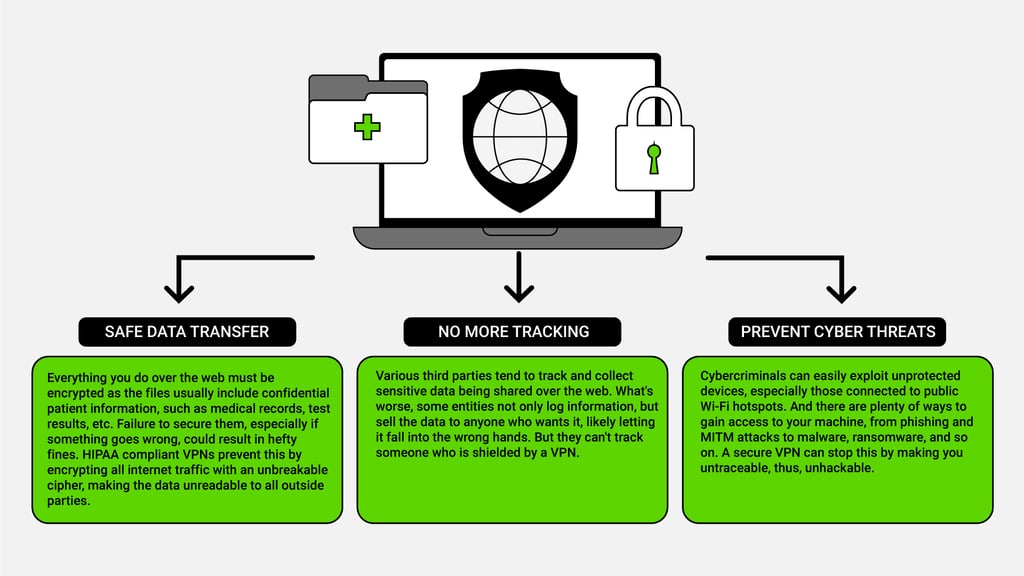
Individual users benefit from:
- Safe data transfer. Everything you do over the web must be encrypted, as the files usually include confidential patient information, such as medical records, test results, etc. Failure to secure them, especially if something goes wrong, could result in hefty fines. HIPAA compliant VPNs prevent this by encrypting all internet traffic with an unbreakable cipher, making the data unreadable to all outside parties.
- No more tracking. Various third parties tend to track and collect sensitive data being shared over the web. What's worse, some entities not only log information but also sell the data to anyone who wants it, likely letting it fall into the wrong hands. But they can't track someone who is shielded by a VPN.
- Prevent cyber threats. Cybercriminals can easily exploit unprotected devices, especially those connected to public Wi-Fi hotspots. And there are plenty of ways to gain access to your machine, from phishing and MITM attacks to malware, ransomware, and so on. A secure VPN can stop this by making you untraceable, thus unhackable.
Choosing a HIPAA compliant VPN service: what you need to know
You need to be extra careful when picking a VPN for HIPAA compliance. The majority of services won’t provide must-have features that should ensure your data safety. So, if you want to avoid any breaches and calamities, pick a secure VPN that meets crucial criteria points.
First and foremost, a HIPAA-compliant VPN must use industry-leading security measures. These are AES-256 encryption, a kill switch, and IP, DNS, and WebRTC leak protection to prevent unexpected disasters. Then, the service shouldn’t collect any data and provide proof that they don’t keep any logs by performing third-party audits. Plus, the VPN should be based outside the Fourteen Eyes alliance to avoid data retention laws.
To ensure the smoothest workflow and information security, go with a provider with open-source tunneling protocols. The current standard is WireGuard and OpenVPN, but you can trust some proprietary protocols, too, like NordLynx. I also recommend considering extra protection-oriented perks. Some providers additionally include threat detectors, dedicated IPs, password managers, 2FA, etc.
Finally, well-rounded device compatibility is also of utmost importance. A HIPAA-compliant VPN should work on popular OS (Windows, macOS, iOS, Android, Linux) for maximum comfort. It ensures you can use the tool on all devices used for medical work.
| Security essentials | Privacy guarantees | Secure tunneling protocols | Broad device support | Extra perks | |
| What to look for | AES-256 encryption, a kill switch, IP, DNS, and WebRTC leak protection | Independently audited no-logs policies, privacy-friendly jurisdictions | OpenVPN, WireGuard, proprietary tunneling protocols | Windows, Linux, macOS, iOS, Android | No device limit, dedicated IPs, threat detectors, password managers, 2FA, data breach scanners, etc. |
A quick guide to meeting your HIPAA requirements
I probably don’t need to spell out every single clause in HIPAA. If you’re reading this, you’re probably already well aware of what the Act contains and what demands it makes from healthcare organizations. But it’s always handy to refresh what we know, especially before assessing some solutions that might be employed.
- Know who is covered. HIPAA covers both Covered Entities (CE), which generally provide physical care for patients and gather data as a result of appointments and procedures. But it also covers Business Associates (BAs), which may have no direct contact with patients. So even if your company provides equipment or data services to healthcare organizations, HIPAA needs to be factored into your security measures.
- Physical protections. All HIPAA-authorized organizations must have procedures that govern physical access to computers and other devices that store or access patient records. It would include things like remote work and the use of SD cards or other removable media.
- Protection against record changes. Technical procedures have to be documented and implemented, which ensures that any changes to patient ePHI are logged and transparent. It also encompasses disaster recovery processes to ensure patient records are secured from theft or harm in emergencies.
- Access controls. It probably goes without saying, but a core component of HIPAA compliance regards user ID control. Anyone with access to healthcare records must be properly authorized. It covers data protection via encryption and authentication software as well.
- Network security. If companies use extended networks or Internet-of-Things technology as part of their operations, this hardware has to be secured from external threats. Any methods of data transmission have to be protected in this way, including on and off-site storage, intranets, and physical hardware.
Increase security with NordVPN
How to ensure HIPAA compliance?
Meeting HIPAA compliance requirements can seem daunting, especially at first glance. However, when you break it down, the conditions stipulated by HIPAA are just a variation of standard cyber and network security.
- Self-audits. HIPAA requires annual audits of the organizations to assess Administrative, Technical, and Physical gaps in compliance.
- Remediation plans. Entities and business associates must implement remediation plans to reverse any compliance violations.
- Policies, Procedures, and employee training. Both parties must develop Policies and Procedures corresponding to HIPAA standards. Employees must get annual training on these policies and procedures.
- Documentation. Organizations must document all efforts taken to become and continue being HIPAA compliant.
- Business Associate Management. Entities and business associates must document who, when, how, and why PHI is being accessed.
- Incident Management. Both parties need to have measures in case of a data breach.
Best business VPN for HIPAA compliance
Of course, there are business-level HIPAA compliance solutions if there’s a need for it. Here are some of the best I’d recommend:
- NordLocker. It’s an end-to-end encrypted file vault with apps for PC and mobile. You can secure files locally on your device or sync them via a zero-knowledge cloud. The Business plan lets companies back up and control access to sensitive information, reducing the risk of data exposure, cyberattacks, and snooping.
- Perimeter 81. The service helps organizations secure health information in the cloud, on-site, and in transit with encryption. Businesses can ensure that access to files is given only to the right people by enforcing 2FA. Plus, it’s a hardware-free cloud VPN solution, so it’s easily scalable along with the company and its growth.
- GoodAccess. A secure SaaS platform with identity-based access control, traffic encryption, MFA, SSO, network segmentation, and online threat prevention. It also includes such features as IP whitelisting, DNS filtering, zero-trust access control, and access logs.
How HIPAA compliant business solutions help organizations
The primary mission of a HIPAA business solution is to protect your information. One of the HIPAA requirements is to ensure clients’ data by encrypting various messages and files, and these do that exactly. They create a safe virtual tunnel that allows the information to pass without interception. Thus, hackers, snoopers, and other malicious third parties won’t be able to get the precious files.
Moreover, there should be technical policies and procedures that only allow authorized personnel to access ePHI. That’s where HIPAA-compliant VPN solutions with centralized cloud management platforms come into play. That way, administrators can create customized user access to sensitive data. That includes SaaS services, cloud environments, and sandbox & production environments.
Lastly, various health institutions must implement procedural mechanisms to record and examine access and other activity in information systems containing or using ePHI. Trustworthy HIPAA VPNs can identify risks and vulnerabilities to your system and data. Plus, activity reports will provide insight into which resources are being accessed.
Conclusion
Staying HIPAA compliant in 2026 requires more than just basic security tools. It takes a premium VPN service to fully meet the requirements of protecting sensitive health data online. When choosing a VPN, it’s essential to focus on invincible encryption, reliable tunneling protocols, and a strict no-logs policy with a proven external audit record. Extra features like dedicated IP addresses, multi-device support, and secure cloud storage are additional compliance safeguards.
After reviewing the top options, I recommend NordVPN and NordLocker. Both deliver the security, privacy, and reliability healthcare organizations need to handle confidential data at the highest standard, staying fully aligned with HIPAA guidelines.

![Surfshark weekly deals logo [IN USE]](https://media.vpnpro.com/surfshark-weekly-deals.svg)
![Proton VPN winner logo [IN USE]](https://media.vpnpro.com/2025/05/protonvpn-winner.png)
You may also like to read:
What is a VPN?
Best no-logs VPNs
Best multi-device VPNs
Best VPN for Windows
Best VPN for Mac
Should I leave my VPN on all the time?
FAQ
How to be HIPAA compliant?
One of the simplest ways to stay HIPAA compliant is by using a reliable VPN service. A good VPN encrypts your data, offers strong security features, and supports safe login methods. This helps meet HIPAA’s strict standards without overthinking it.
What is the best HIPAA compliant VPN?
My top recommendation for small businesses is NordLocker. It works as an encrypted vault to store, manage, sync, and share sensitive files across your team safely and easily.
Can I use a free HIPAA compliant VPN?
While free VPNs exist, they often lack strong security and have many vulnerabilities. So, no, they do not reliably meet HIPAA requirements. For proper compliance and safety, it’s better to use a trusted premium service like NordVPN.
Why use a VPN in healthcare?
A VPN protects healthcare data by securing the network that stores and transfers sensitive patient information. It makes sure data can’t be seen or intercepted by outsiders. Using a VPN is especially important for healthcare professionals working remotely and accessing records from their personal devices on less private networks.
What makes a network HIPAA compliant?
A HIPAA compliant network protects sensitive health information by using encryption, secure cloud storage, and access controls. It limits who can view or change sensitive data to keep patient information safe at all times.


- Best HIPAA-compliant VPNs for personal use: shortlist
- What is HIPAA compliance?
- HIPAA violation tiers
- Is VPN HIPAA compliant?
- HIPAA VPNs for personal use
- How VPNs ensure HIPAA compliance?
- Choosing a HIPAA compliant VPN service: what you need to know
- A quick guide to meeting your HIPAA requirements
- How to ensure HIPAA compliance?
- Best business VPN for HIPAA compliance
- How HIPAA-compliant business solutions help organizations
- Conclusion
- FAQ