Surfshark vs Proton VPN: which is better in June 2026


- ✅ Surfshark is the fastest VPN for streaming. It retained over 93% of my base internet speed during testing with the WireGuard protocol, and it consistently unblocked Netflix, Hulu, and BBC iPlayer in 4K.
- ✅ Proton VPN is ideal for privacy and transparency. It has a transparent no-logs policy and uses advanced encryption to protect your data. Plus, Secure Core servers route your traffic through multiple secure locations.
Surfshark and Proton VPN are both reliable providers, but they are quite different at the same time. While Surfshark is the fastest VPN for streaming and gaming with unlimited device connections, Proton VPN focuses more on privacy, offering tools like NetShield and Tor over VPN. As a result, I compared both providers through thorough testing to help you see their strengths and weaknesses. I analyzed several factors, including speed and security as well as apps and usability. After testing them head-to-head, Surfshark stands out as the better VPN for most users. Read on to learn why.


Since 2018, VPNpro has delivered unbiased, expert-backed insights through in-house research and thorough VPN testing. Our team ensures every review is fact-checked and reliable. Learn how we maintain these high standards in our testing methods.
Surfshark vs Proton VPN compared
| VPN provider: | Surfshark | Proton VPN |
| Official website: | https://surfshark.com/ | https://protonvpn.com/ |
| Rating: | 9.5⭐⭐⭐⭐⭐ | 8.6⭐⭐⭐⭐ |
| Based in: | Netherlands | Switzerland |
| Servers: | 4,500+ servers in 100 countries | 20,075+ servers in 145 countries |
| Streaming support: | Netflix, Prime Video, Disney+, BBC iPlayer, HBO Max, Hulu, Hotstar, IPTV, Crunchyroll, Roku, and more | Netflix, Hulu, Disney+, BBC iPlayer, HBO Max, Hallmark, DAZN, Peacock, Paramount+, Prime Video, and more |
| Torrenting support: | ✅Yes, P2P optimized servers | ✅Yes, P2P optimized servers |
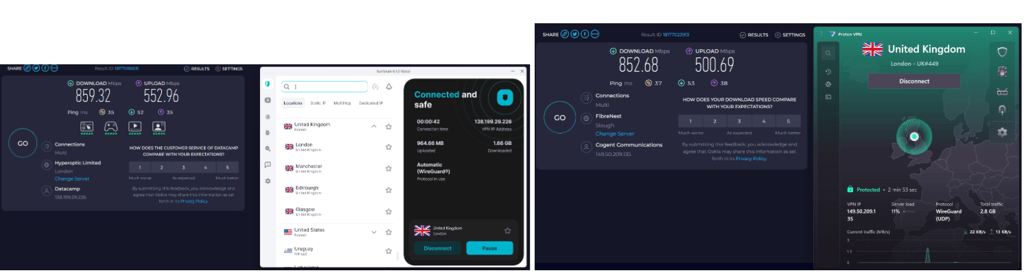
| Speed: | Very fast (~785Mbps) | Fast (~770Mbps) |
| Logs: | Independently audited by Deloitte | Independently audited by Securitum |
| Number of devices: | Unlimited | 10 |
| Price: | From $1.99/month | From $2.99/month |
| Coupon: | Surfshark coupon 87% OFF | Proton VPN coupon 70% OFF |
![Surfshark winner logo [IN USE]](https://media.vpnpro.com/images/160x40/2025/04/surfshark-160x40.png)
Key differences between Surfshark and Proton VPN
Surfshark and Proton VPN have both grown extremely popular in the VPN market, offering strong security, privacy, and streaming capabilities. Surfshark launched in 2018, while Proton VPN started in 2017. While both serve the same purpose for users, they differ in focus and features, particularly in privacy, security tools, speed, and pricing models.
| When to choose Surfshark | When to choose Proton VPN |
| ✅ When you want to use a VPN on multiple devices. Surfshark allows unlimited simultaneous connections, so you can share the connection with your friends and family. | ✅ If you value transparency. Proton VPN has a strict no-logs policy, which means its apps are independently audited and fully open-source. |
| ✅ If you want fast streaming. Surfshark consistently delivers 93% retention speed with WireGuard, making 4K streaming smooth. | ✅ When you need to bypass censorship. Proton VPN consistently unblocks streaming platforms and bypasses geo-restrictions and censorship. |
| ✅ When you want to watch geo-restricted content. Unblocks the most popular streaming services, including Netflix, Prime Video, Disney+, BBC iPlayer, Peacock, Paramount+, Hulu, Crunchyroll, Roku, and more. | ✅ When you need a huge server network. With over 14,000 servers in 122 countries, the provider uses the latest technology to implement and strengthen servers around the world. It allows users to experience less congestion, choose more locations, and enjoy more stable connections. |
| ✅ When you need an affordable VPN. Surfshark is a budget-friendly VPN, with prices starting at just $1.99/month. | ❌ Limited free version. You can't access all server features, higher speeds, or the entire server network with the free plan. |
| ❌ If you want to try it for free. Surfshark offers a 7-day free trial and a 30-day money-back guarantee, but it doesn't offer a free version permanently, as Proton VPN does. | ❌ Higher price. Proton VPN’s premium plans are higher (starting from $4.49/month) than Surfshark's ($1.99/month). |
Here are the main differences between Surfshark and Proton VPN:
- Surfshark is cheaper. Its long-term plans are significantly cheaper than Proton VPN's. For example, Surfshark costs $3.19/month ($47.85 total) for 1 year, and Proton VPN costs $3.99/month ($59.88 total). On a 2-year plan, Surfshark is cheaper and the subscription is $1.99/month ($53.73 total), while Proton VPN is $2.99/month ($107.76 total).
- Proton VPN has a larger server network with over 20,075 servers across 145 countries, while Surfshark offers 4,500+ servers in 100 countries.
- Surfshark is more reliable for streaming. Surfshark consistently unblocks Netflix, Disney+, BBC iPlayer, and more with smooth HD/4K quality and unlimited device connections. In spite of Proton VPN's solid security, streaming is less reliable, with frequent server changes and slower speeds.
- Proton VPN is better for torrenting. A larger server network and port forwarding enable smoother, more stable peer-to-peer transfers.
- Surfshark is ideal for gaming. It dynamically manages server load and routes traffic efficiently, which keeps ping consistently low. Plus, DDoS protection and unlimited bandwidth ensure stable matches and uninterrupted gaming.
- Proton VPN offers a free version. The Proton VPN plan is free and offers unlimited data, unlike Surfshark, which has only a 7-day free trial.
- Surfshark supports unlimited devices. Proton VPN only allows a maximum of 10 connections, which makes Surfshark more versatile for households with multiple devices.
- Proton VPN is stronger in privacy and security. Users with privacy concerns can rely on its Secure Core servers and open-source applications for strong protection.
- Surfshark is faster. Surfshark consistently retained over 93% of its base speed for streaming, while Proton VPN only retained 82%.
Final verdict:
Surfshark vs Proton VPN price comparison
Surfshark is cheaper than Proton VPN on both a 1-year and 2-year plan. Surfshark's Starter plan costs $3.19/month ($47.58 total) for 12 months compared to Proton VPN's at $3.99/month ($59.88 total). On a 2-year plan, the Surfshark Starter plan is more affordable at just $1.99/month ($53.73 total), while Proton VPN is $2.99/month ($107.76 total). Additionally, Proton VPN offers a free version, and its paid monthly plan is $9.99, which is more affordable than Surfshark's $15.45.
The main difference between Surfshark and Proton VPN is that Surfshark offers three different plan options with extra bundles. This allows you to customize your plan according to your exact needs. As for Proton VPN, there are only three options available, both short-term and long-term. Here is a comparison of the providers' prices and policies:
| VPN plan | Surfshark | Proton VPN |
| 1-month plan | $15.45 | $9.99 |
| 1-year plan | $3.19/month ($47.85 total) | $3.99/month ($59.88 total) |
| 2-year plan | $1.99/month ($53.73 total) | $2.99/month ($107.76 total) |
| Long-term savings | Save 87% on a 2-year plan | Save 70% on a 2-year plan |
| Free trial | 7-day trial | Free version |
| Money-back guarantee | 30-day guarantee | 30-day guarantee |
| Best for | Users who want fast speeds, strong security, and unlimited simultaneous connections across multiple devices | Users who value high-quality privacy, secure protocols, reliable performance for streaming and browsing, and a free version plan. |
Both VPN providers offer a 30-day money-back guarantee, allowing you to request a refund if you’re not happy with the product. Proton VPN also provides a free plan with unlimited bandwidth, but it is limited to one device, while Surfshark offers a 7-day free trial for Android and iOS.
Surfshark is cheaper on long-term subscription plans, whereas Proton VPN has a lower monthly price. Both providers offer discounts on extended subscriptions, but Surfshark’s two-year plan is significantly cheaper than Proton VPN’s.
Servers and locations: Proton VPN vs Surfshark
Proton VPN boasts a much larger server fleet, with over 20,075 servers across 145 countries, while Surfshark offers over 4,500 servers in 100 countries. However, on a regional level, Proton VPN has a strong presence in the US, with over 3,576 servers located across all major cities, including New York, Miami, Chicago, and Dallas. Surfshark's network has over 600 servers, including New York, Nebraska, Washington, and California. In Europe, Proton VPN operates 7,826+ servers, while Surfshark has 1,500+ servers in key countries like the UK, France, Germany, and Switzerland. For the Asia-Pacific region, I noticed a considerable difference. For instance, Proton VPN has over 1,607 servers in Japan, Australia, and India, whereas Surfshark has servers in 27 countries, including Japan, Australia, Hong Kong, and others, although the exact number of servers isn't disclosed. Thus, Proton VPN has a superior server network spread throughout the world compared to Surfshark.
| Servers and locations feature | Surfshark | Proton VPN |
| Total number of servers worldwide | 4,500+ servers | 20,075+ servers |
| Countries covered | 100 countries | 145 countries |
| US servers | 600+ servers in New York, Virginia, Massachusetts, Michigan, North Carolina, Illinois, Georgia, Tennessee, Florida, Kansas, Nebraska, Texas, Colorado, Utah, Arizona, Nevada, Oregon, Washington, California | 3,576+ servers in New Jersey, California, Georgia, Virginia, Texas, New York, California, Illinois, Arizona, Florida, Massachusetts, Ohio, Pennsylvania, Tennessee, District of Columbia (DC), Texas, Colorado, Washington, Utah |
| European servers | 1,500+ servers in Albania, Andorra, Armenia, Austria, Belgium, Bosnia & Herzegovina, Bulgaria, Croatia, Cyprus, Czech Republic, Denmark, Estonia, Finland, France, Germany, Greece, Hungary, Iceland, Ireland, Isle of Man, Italy, Latvia, Liechtenstein, Lithuania, Luxembourg, Malta, Monaco, Montenegro, Netherlands, North Macedonia, Norway, Poland, Portugal, Romania, Serbia, Slovakia, Slovenia, Spain, Sweden, Switzerland, United Kingdom | 7,826+ servers in Albania, Armenia, Austria, Belgium, Bosnia & Herzegovina, Bulgaria, Croatia, Cyprus, Czechia, Denmark, Estonia, Finland, France, Germany, Greece, Hungary, Iceland, Ireland, Italy, Latvia, Lithuania, Luxembourg, Malta, Montenegro, Netherlands, North Macedonia, Norway, Poland, Portugal, Romania, Serbia, Slovakia, Slovenia, Spain, Sweden, Switzerland, United Kingdom |
| Asia-Pacific servers | Servers in 27 countries (Australia, Azerbaijan, Bangladesh, Bhutan, Brunei, Cambodia, Hong Kong SAR China, India, Indonesia, Japan, Kazakhstan, Laos, Macau, China, Malaysia, Mongolia, Myanmar, Nepal, New Zealand, Philippines, Singapore, South Korea, Sri Lanka, Taiwan, Thailand, Uzbekistan, Vietnam) | 1,607+ servers in Afghanistan, Australia, Azerbaijan, Bangladesh, Bhutan, Brunei, Cambodia, Georgia, Hong Kong SAR China, India, Indonesia, Japan, Kazakhstan, Laos, Malaysia, Moldova, Mongolia, Myanmar, Nepal, New Zealand, Pakistan, Philippines, South Korea, Sri Lanka, Taiwan, Tajikistan, Thailand, Turkmenistan, Turkey, Ukraine, Uzbekistan, Vietnam |
| Specialized servers | ✅Yes, Dynamic MultiHop, IP Rotator, Camouflage Mode, Dedicated IP | ✅Yes, P2P, Tor, Secure Core, Dedicated IP, streaming-optimized servers |
Proton VPN's massive server fleet and broader geographical coverage optimize load and reduce congestion. This is crucial for maintaining fast, stable connections, especially when connecting to servers far away. Proton VPN's wider geographical spread also makes it more effective for unblocking region-locked content. However, as Proton VPN's free version is limited and has few servers in the US, Japan, the Netherlands, Poland, and Romania, you won't be able to unblock Netflix in the US or Crunchyroll in Japan. In this case, you will need to opt for the premium version.
I also looked closely at specialty servers. One of the key advantages of Proton VPN's servers is its privacy-first infrastructure. It offers Secure Core servers that route traffic through multiple secure locations and dedicated servers for P2P and Tor, prioritizing anonymity. On the other hand, Surfshark’s entire network runs on RAM-only infrastructure, which means that all information is automatically wiped clean with every reboot or power outage. I also explored its MultiHop servers, which route traffic through two different locations for extra privacy, and its Camouflage Mode is also solid for bypassing strict firewalls. So while both services offer unique benefits, Proton VPN wins in this category because of its significantly larger server count.
![Proton VPN winner logo [IN USE]](https://media.vpnpro.com/images/160x40/2025/05/protonvpn-winner.png)
Proton VPN vs Surfshark security overview
Surfshark and Proton VPN are both strong VPN contenders, but they approach security differently. While Surfshark offers a compelling package with unlimited connections, competitive pricing, and fast speeds, Proton VPN's security-first philosophy makes it the better choice for users who prioritize protection and anonymity. Below is a detailed breakdown of the key security features each VPN offers:
| Security feature | Surfshark | Proton VPN |
| Encryption standard | AES-256, ChaCha20 | AES-256, ChaCha20 |
| Protocols supported | OpenVPN, IKEv2, WireGuard, | OpenVPN, WireGuard, IKEv2, Stealth |
| Kill switch | ✅Yes, network-wide | ✅Yes, network-wide |
| DNS/IPv6 leak protection | Built-in DNS and IPv6 leak protection | Built-in DNS and IPv6 leak protection |
| No-logs policy | Independently audited | Independently audited |
| Multi-hop (Double VPN) | ✅Yes | ✅Yes |
| Obfuscation / Stealth servers | ✅Yes | ✅Yes |
| Threat protection / Malware blocking | ✅Yes | ✅Yes |
| RAM-only servers | ✅Yes | ❌No |
| Security audit | 2025 audit by Deloitte | 2024 audit by Securitum |
I've researched both Proton VPN and Surfshark and found they share a lot of the same core security features. Both use AES-256 encryption, along with ChaCha20 for WireGuard. Moreover, Proton VPN's software is completely open-source and has been independently audited by a third-party security firm. This level of transparency is rare and provides a lot of reassurance. Surfshark also completed its fifth independent audit by Deloitte.
I also looked at each provider’s unique security features. I was impressed with Proton VPN’s Secure Core servers, which route traffic through physically secure data centers for an extra layer of protection. Its dedicated Tor over VPN servers are another strong advantage for users seeking maximum anonymity. Surfshark, on the other hand, uses RAM-only servers, meaning no data is ever written to disk, which enhances security and ensures all information is wiped with every server reboot. Both approaches provide strong protection, but Proton VPN focuses on a privacy-first infrastructure, while Surfshark emphasizes hardware-level data security.
Encryption and VPN protocols
Surfshark and Proton VPN rely on modern encryption standards, including AES-256 and ChaCha20 for WireGuard, ensuring your traffic stays secure from hackers and surveillance. In terms of protocols, both providers support WireGuard, OpenVPN, and IKEv2, giving you a balance between speed and privacy. However, Surfshark’s WireGuard implementation delivered slightly faster speeds in my tests, while Proton VPN adds Stealth mode for bypassing network restrictions. Overall, both VPNs provide strong encryption and protocol options, but Surfshark is better for speed-focused users, whereas Proton VPN is ideal for privacy-conscious users needing extra obfuscation.
Kill switch and leak protection
A VPN kill switch is a crucial feature that prevents your real IP address from leaking if your VPN connection unexpectedly drops. Both Surfshark and Proton VPN offer network-wide kill switches, meaning your entire internet connection is blocked to prevent data exposure. Additionally, both VPN services offer built-in DNS and IPv6 leak protection, which adds an extra layer of security to the connection by preventing any type of leak.
However, I found a key difference between their implementations. Surfshark's kill switch is straightforward and reliable, ensuring your privacy is maintained. Proton VPN goes a step further by offering a more advanced kill switch feature in its desktop apps. This feature prevents internet access at all times, including during system startup and when the VPN app isn't running.
Advanced VPN security features
Surfshark includes Dynamic MultiHop, which routes your traffic through two servers for extra privacy. It also includes IP Rotator and Camouflage Mode to mask your connection, as well as RAM-only servers that ensure no data is stored and everything is wiped upon reboot. Proton VPN, meanwhile, provides Secure Core servers, Tor over VPN, and streaming-optimized servers for privacy and anonymity. While both VPNs excel at bypassing restrictions in high-censorship regions, Surfshark’s RAM-only infrastructure and rotation features make it especially strong for everyday privacy and secure streaming. Proton VPN, on the other hand, focuses on privacy-first routing and maximum anonymity for users who prioritize security.
Extra protection - malware, ads, and trackers
Surfshark includes a built-in threat protection suite called CleanWeb, which blocks ads, trackers, malicious sites, and cookie pop-ups. I reviewed this, especially useful when streaming or browsing, as it keeps the experience smooth and secure. Proton VPN also provides similar protection with its NetShield feature. I tested this tool and found that it blocks ads well and protects against malware and trackers. The main difference I noticed is that while both are great, Surfshark's CleanWeb feels slightly more robust in its features and ease of use.
Is Surfshark better than Proton VPN in terms of privacy and security?
I tested Proton VPN and Surfshark extensively and found them highly reliable for privacy and security. Both have strict, independently audited no-logs policies, but there are some important differences in their jurisdictions and features. For instance, Proton VPN stands out with its jurisdiction in Switzerland, a country known for some of the world's strongest privacy laws and no data retention agreements. I also like that all of its apps are open-source and transparent. On the other hand, Surfshark is based in the Netherlands, a member of the Nine-Eyes intelligence-sharing alliance. Despite this concern, Surfshark reinforces its privacy claims with a strict no-logs policy and an increasing number of independent audits.
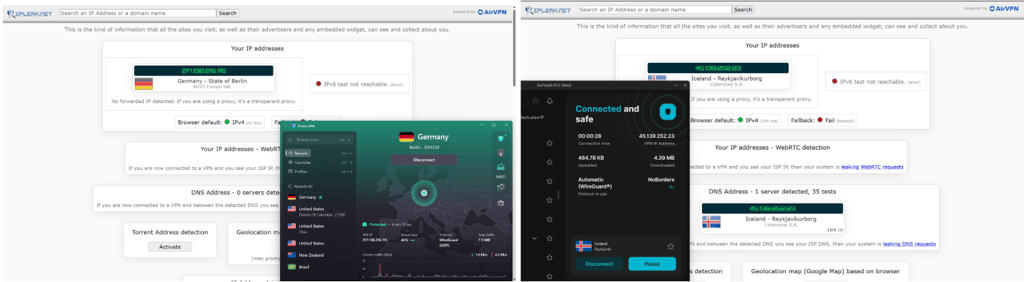
I ran IP and DNS leak tests on both services using ipleak.net and dnsleaktest.com to ensure privacy. Both Surfshark and Proton VPN delivered stable connections with no leaks when I connected to servers in different countries and initiated connection drops.
Proton VPN vs Surfshark privacy and logs
Proton VPN is based in Switzerland, a country with strong privacy laws and no mandatory data retention, which makes it highly privacy-friendly. Surfshark, on the other hand, is headquartered in the Netherlands, a member of the Nine Eyes alliance, meaning it could be subject to international intelligence-sharing agreements.
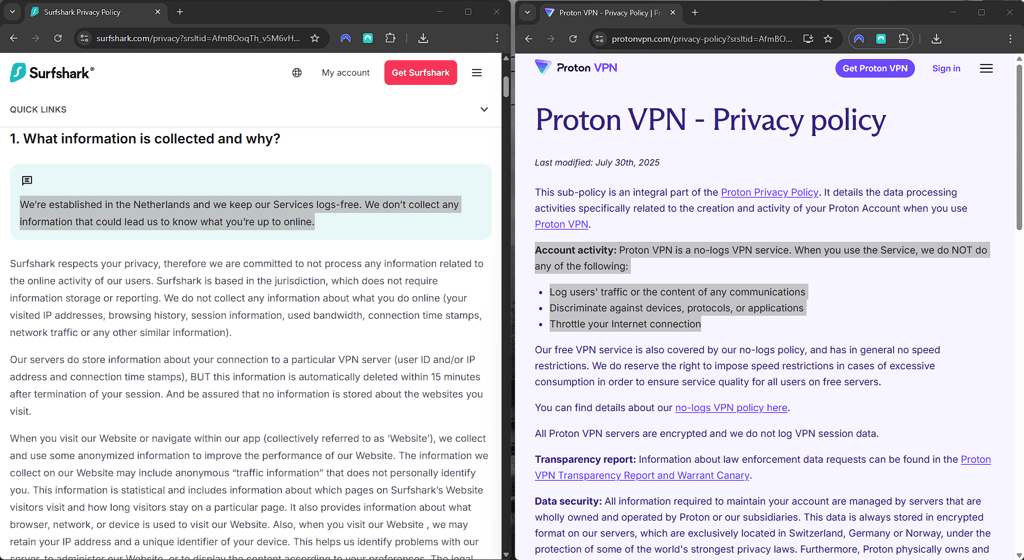
Both providers maintain strict no-logs policies that have been independently audited. Proton VPN’s open-source apps and audits by Securitum confirm that no user traffic is stored, while Surfshark has also undergone multiple audits verifying its zero-log claims. In both cases, only the necessary account and payment information is retained.
Overview of independent audits
Based on my research, both Proton VPN and Surfshark demonstrate a strong commitment to user privacy by regularly submitting their no-logs policies and infrastructure to independent audits. Proton VPN's latest security audit, conducted by Securitum in July 2024, confirmed its strict no-logs policy. Additionally, it successfully completed its first SOC 2 Type II audit in July 2025. This verifies its robust security and operational practices, including Proton VPN, Mail, Calendar, and Password Manager. Proton VPN's internal security controls were audited by Schellman in July 2025, providing businesses with a high level of assurance regarding data protection and privacy.
However, Surfshark verified its no-logs policy with Deloitte in June 2025. Deloitte, one of the "Big Four" auditing firms, conducted a comprehensive review of Surfshark's IT systems and infrastructure. This included an examination of various server types to ensure user data was not logged. Moreover, Surfshark makes its full audit reports available to its users.
Finally, both VPNs are trustworthy, but Proton VPN is slightly more reliable due to its more extensive audit history, which includes a wider range of security and operational checks beyond just its no-logs policy. The company's commitment to making its apps open-source and submitting them for audit further reinforces its credibility. However, Surfshark's use of a globally recognized firm like Deloitte and its commitment to regular audits also make it a very reliable and trustworthy choice.
Surfshark or Proton VPN for streaming
Based on my tests, Surfshark is a slightly better option for streaming than Proton VPN, offering a smoother and faster experience. However, Proton VPN is a very strong contender with its unique technology and robust streaming capabilities.
I compared both VPNs by testing my baseline connection and then connecting to servers in the US, UK, France, and Japan. I found that Surfshark consistently retained 93% of my original speeds, while Proton VPN retained 83%. While both speeds are more than sufficient for streaming in HD and 4K without lag, Surfshark provided a smoother experience with fewer buffering issues.
| Streaming service | Surfshark | Proton VPN |
| Netflix | ✅Works with various Netflix libraries (US, UK, Japan) | ✅Works with various Netflix libraries (US, UK, Japan) |
| Amazon Prime Video | ✅Unlocked US and UK content | ✅Unlocked US and UK content |
| Disney+ | ✅Bypassed geo-restrictions without issues | ✅Bypassed geo-restrictions without issues |
| HBO Max | ✅Works with HBO Max’s libraries | ✅Works with HBO Max’s libraries |
| Hulu | ✅Works with US and Japan servers | ✅Works with US servers |
| Peacock | ✅Works with US servers for full access | ✅Works with US servers |
| Paramount+ | ✅Unblocks UK and US content without issues | ✅Unblocks UK and US content without issues |
| YouTube TV | ✅Works with various US servers | ✅Works with various US servers |
| ESPN+ | ✅Fully works with US servers | ✅Works with US servers |
| Sky Go | ✅Works reliably with UK and Ireland servers | ✅Works reliably with UK servers |
| ITVX | ✅Works reliably with UK servers | ⚠️Works with UK servers but may be inconsistent |
| All 4 | ✅Works with UK servers | ⚠️Works with UK servers but can be inconsistent |
Additionally, Proton VPN’s performance is boosted by its unique VPN Accelerator technology. This feature is designed to increase speeds by up to 400%, particularly on long-distance connections. As a result, even though Surfshark had higher overall speeds, I found that Proton VPN’s speeds were incredibly stable and reliable, even on distant servers.
Surfshark and Proton VPN unblocked a wide range of popular geo-restricted platforms. It was impressive to see both services bypass Netflix's strict VPN block, enabling me to easily access Netflix US and Netflix Japan libraries from anywhere in the world. Both also bypassed region-restricted platforms like BBC iPlayer, Hulu, and HBO Max.
It's important to mention a key difference I found: Proton VPN's free plan does not unblock streaming services. To access and stream geo-blocked content, you must subscribe to a premium plan, which provides access to its dedicated streaming-optimized servers. In contrast, all of Surfshark's paid plans are designed to unblock streaming platforms effectively.
Which VPN can unblock Netflix? Testing result
During my tests, I wanted to delve deeper into Netflix as it's one of the most popular streaming platforms, and to see how each VPN performs. Netflix produces different content from various locations due to geographical restrictions and licensing agreements. My tests showed that both providers can easily bypass these blocks and allow you to switch between libraries without lags or interruptions seamlessly. With both Surfshark and Proton VPN, I was able to access different content using Netflix in the US, Canada, Japan, South Korea, India, the UK, and Hong Kong.
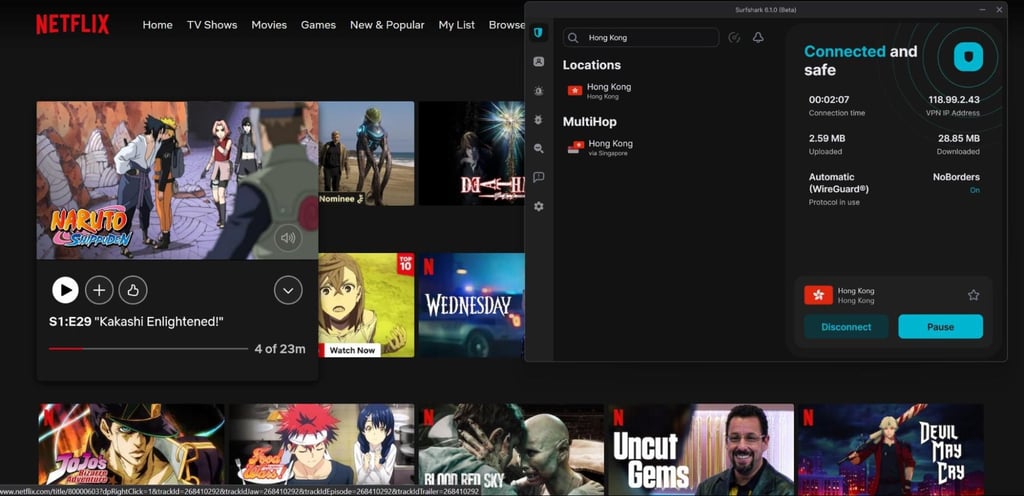
My goal was to test a popular show, such as Naruto Shippuden. While this title is not available in all Netflix libraries, it is accessible through Netflix Hong Kong, which has both VPNs unblocked. Plus, it's important to note that Proton VPN's free plan does not support streaming and cannot unblock these regional Netflix libraries. To access streaming services, you must upgrade to a premium plan.
Surfshark or Proton VPN for torrenting
Torrenting without a VPN is risky, as your IP address is exposed to other users in the swarm. This can lead to security vulnerabilities, legal issues, and ISP throttling, where your internet provider intentionally slows down your connection. For this reason I tested both VPN providers and Proton VPN is a better choice for torrenting than Surfshark due to its dedicated P2P servers and significantly faster speeds in this specific use case. Using qBittorrent on Windows 11 while downloading the 5.65 GB Ubuntu 24.10 file, Proton VPN averaged 56.9 Mbps, nearly double Surfshark’s 27.1 Mbps. Neither VPN caused throttling or disconnections, and both blocked IP/DNS leaks while triggering the kill switch properly when tested.
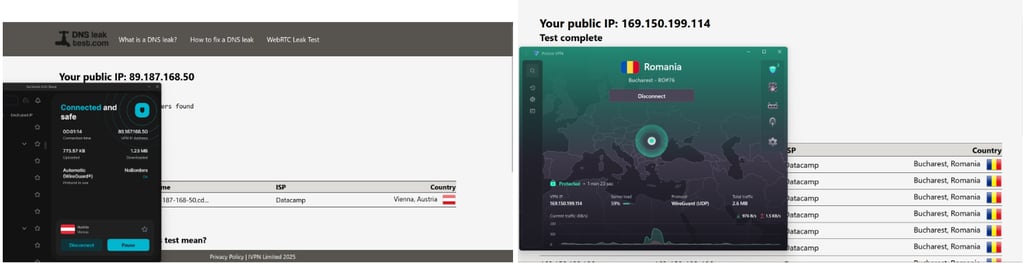
I also tested both VPNs on multiple servers across the US, Europe, and Asia. Both services maintained a stable connection with no IP or DNS leaks, and their kill switches worked perfectly when I simulated a connection drop. This is a crucial feature for torrenting, as it ensures your real IP address is never exposed.
A key difference is their approach to P2P traffic. Proton VPN has specialized P2P servers designed for torrenting, and it also supports port forwarding, which can further boost speeds. Surfshark, while supporting torrenting on all its servers, does not have dedicated P2P servers. I found Proton VPN's dedicated P2P servers to provide a significant speed advantage, even though user feedback indicated there was no noticeable difference. Although Surfshark's MultiHop servers can provide an extra layer of privacy by routing traffic between two servers, I found that it reduced torrenting speeds notably, making it less practical for torrenting large files or frequently.
Surfshark vs Proton VPN for gaming
Using a VPN for gaming isn’t just about privacy, it can help bypass geo-restrictions, protect you against DDoS attacks, and prevent ISP throttling. The best gaming VPN should deliver low ping, no bandwidth caps, and stable connections across regions. Both Surfshark and Proton VPN support gaming, work with consoles/routers, and provide strong encryption and kill switches for protection.
In my tests, Surfshark proved better for gaming than Proton VPN, especially in terms of ping stability. I measured the ping in three popular multiplayer games - League of Legends, Valorant, and CS:GO. Surfshark delivered noticeably lower ping in League of Legends (27ms vs. Proton VPN’s 76ms) and slightly better results in Valorant (49ms vs. 54ms). Proton VPN, however, edged out Surfshark in CS:GO with 50ms compared to 56ms.
Neither VPN imposed throttling or bandwidth caps during my sessions, and both shielded against IP/DNS leaks while handling sudden connection drops. Surfshark doesn’t offer dedicated gaming servers but delivered consistently lower ping. Although Proton VPN has a strong infrastructure, latency was noticeably high, especially outside Europe.
Overall, Surfshark is the stronger choice, with faster response times and smoother connections. Proton VPN is still reliable, but if you want to reduce lag in competitive matches, Surfshark is the safer bet.
VPN connection limits: Surfshark vs Proton VPN
Surfshark has no limit on simultaneous connections, which is one of its strongest advantages. You could secure all your devices, such as a laptop, phone, work computer, and even my Fire TV Stick. Proton VPN, on the other hand, limits you to 10 devices.
Both VPNs support all operating systems: Windows, macOS, Android, iOS, and Linux. It also works with smart TVs, and Android TV. Surfshark goes further with built-in support for routers and game consoles, which Proton VPN lacks unless you set it up manually. That makes Surfshark the better choice if you want to protect Xbox, PlayStation, or your entire home network.
The installation process for both was straightforward in my experience. Surfshark’s apps are lighter and quicker to set up, with a clean interface that makes server switching simple. Proton VPN’s installation was also easy, but what stood out was its profile system, which let me save different configurations (like Streaming US or Torrenting Europe) and connect in one click. Surfshark’s standout feature is its intuitive CleanWeb ad blocker and unlimited device policy, both of which added a lot of value for me.
In short, if you want unlimited connections and device compatibility, Surfshark is the winner. But if you like more personalized control over your VPN usage, Proton VPN’s profile system is a feature I found surprisingly useful.
Note. Use a VPN on a router to get unlimited connections. Using a VPN on your router counts as only one connection, but it protects every device that connects to it, without the need to install VPN software on each individual device.
Surfshark vs Proton VPN Reddit reviews and opinions 2026
I've explored recent discussions on Reddit to see what real users are saying about Surfshark and Proton VPN. I found that while both services have strong supporters, users often recommend one over the other based on their specific needs.
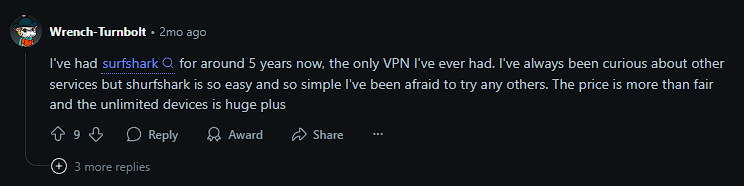
According to Reddit users, Surfshark offers a great value, especially with its unlimited simultaneous connections. As one user noted, they've had Surfshark for five years and its easy, simple interface and "more than fair" prices make it a huge plus. Redditors praise the service's affordability and generous device policy, making it a popular choice for families and users with multiple devices. After thorough testing, Surfshark's unlimited connections are a standout feature that few other providers can match. I also found the apps very user-friendly, and its overall user experience is clean and intuitive. However, some older posts mention slow speeds, but my own tests showed that Surfshark is very fast, with a high-speed retention rate, especially when using the WireGuard protocol.
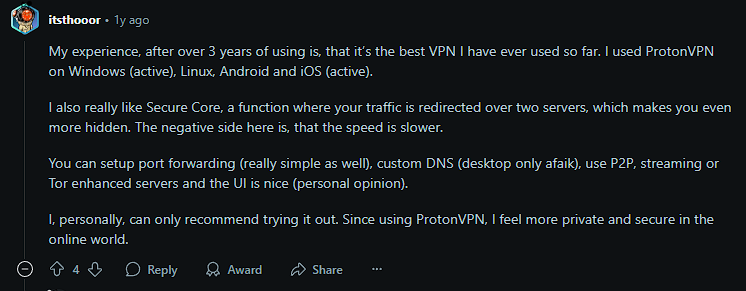
Proton VPN is recognized on Reddit for its privacy and security-first approach. One user highlighted their experience after over three years of use, calling it the "best VPN" they've ever used. They also specifically mentioned the Secure Core feature, which they say makes them feel "more private and secure in the online world." I support and agree with these comments as Proton VPN's commitment to security, with its Swiss jurisdiction, open-source apps, and features like Secure Core, gives it a unique advantage in the privacy category. Moreover, users also mention its free unlimited data plan. While some users reported that the free servers could be slow, I found that the premium servers offered reliable speeds, and VPN Accelerator technology made long-distance connections stable.
Surfshark vs Proton VPN: which one wins?
Both Surfshark and Proton VPN are reliable VPNs, but they have different strengths. Surfshark offers great value with unlimited device connections, consistently fast speeds, and reliable streaming performance. Proton VPN, on the other hand, provides more comprehensive security and privacy features, thanks to its privacy-friendly jurisdiction and open-source applications. Overall, for users who prioritize advanced privacy and transparency, Proton VPN is the better choice. If cost, unlimited devices, consistent streaming speeds, and everyday usability are your main concerns, Surfshark is the clear winner in 2026. Here is a summary of my findings from both VPNs:
| Category | Winner |
| Security | Proton VPN – based in Switzerland, uses AES-256 and ChaCha20 encryption, along with protocols like OpenVPN, WireGuard, Stealth protocol and routes traffic through the Secure Core with Tor network. While Surfshark is also highly secure, Proton VPN's commitment to security is highly advanced. |
| Streaming | Surfshark – reliably unblocks Netflix, Disney+, Hulu, BBC iPlayer, and other platforms, delivering smooth 4K and HD playback. Proton VPN also bypasses geo-restrictions, butit requires to upgrade to a premium plan, which cost more. |
| Privacy | Proton VPN – it is based in Switzerland, a privacy-friendly country with no data retention laws, open-source apps and transparency. This is a key advantage over Surfshark, which is headquartered in the Netherlands, a Nine Eyes Alliance member. |
| Speed | Surfshark – it averaged 780Mbps with its WireGuard protocol, compared to Proton VPN's average of 770Mbps. While both are very good, Surfshark maintains a slight but noticeable edge, especially on long-distance connections where this difference can prevent lag and buffering. |
| Pricing | Surfshark – it costs $1.99/month for its 2-year plan, while Proton VPN is more expensive, with a starting price of $2.99/month. |
| Extra features | Surfshark – offers MultiHop, Bypasser, CleanWeb, NoBorders Mode, IP Rotator, Alternative ID and GPS Spoofing. It also provides unlimited simultaneous connections for every family member. |
In case you are still unsure which provider to choose, I recommend that you test both providers. Surfshark offers a 7-day free trial on iOS, Android, and macOS platforms. Additionally, it has a 30-day money-back guarantee on all plans, allowing you to test the service risk-free for an entire month. Proton VPN also provides a 30-day money-back guarantee on all paid plans. However, Proton VPN has a free unlimited data plan. While this free plan does not support streaming or P2P, it provides access to limited server options in five countries: the Netherlands, Japan, Romania, Poland, and the United States. These options are a great way to find the best fit for your needs without financial risk.

![Surfshark weekly deals logo [IN USE]](https://media.vpnpro.com/surfshark-weekly-deals.svg)
![Proton VPN winner logo [IN USE]](https://media.vpnpro.com/2025/05/protonvpn-winner.png)
FAQ
Is Surfshark better than Proton VPN?
Yes, Surfshark is better than Proton VPN as it provides fast speeds, advanced features, and cheaper prices. Surfshark delivers faster servers and lower ping, which makes it more reliable for streaming and gaming. Plus, it allows unlimited simultaneous connections, while Proton VPN limits them depending on your plan.
How reliable is Surfshark compared to Proton VPN for unblocking content?
Surfshark and Proton VPN are reliable for unblocking geo-restricted content. In my tests, Surfshark worked smoothly with Netflix, Disney+, Hulu, and BBC iPlayer, while Proton VPN also bypassed restrictions. However, with Proton VPN you need to upgrade to a premium plan (starting at $2.99/month), since the free plan does not support streaming or unblocking features. Surfshark, on the other hand, includes streaming support across all plans, making it a more affordable choice for consistent access.
Is Proton VPN easier to use than Surfshark?
Both Surfshark and Proton VPN are very easy to use, with clean and intuitive apps. Surfshark is slightly simpler, making it ideal for beginners who just want a one-click solution. With Proton VPN, you'll be able to customize your profiles and view a world map, which gives you more control over your connection.
Which VPN is more affordable, Proton VPN or Surfshark?
Surfshark is cheaper than Proton VPN, especially on long-term plans. While Proton VPN has a lower monthly price ($9.99/month) for a 1-month subscription, Surfshark offers significantly larger discounts on its annual (starting from $3.19/month) and two-year plans (starting from $1.99/month), making it the more budget-friendly option for long-term use. Plus, Surfshark's unlimited simultaneous connections provide better value for families or users with many devices.
How good is the customer support of Surfshark vs Proton VPN?
Surfshark and Proton VPN both provide excellent customer service, but they have different strengths. Surfshark's major advantage is its 24/7 live chat, which provides instant assistance whenever you need it. Proton VPN offers live chat, but not available 24/7. As part of its commitment to privacy, Proton VPN's support requests can be encrypted end-to-end. Ultimately, Surfshark is better for quick, immediate help, while Proton VPN is a secure choice for users who prioritize privacy in all communications.


